
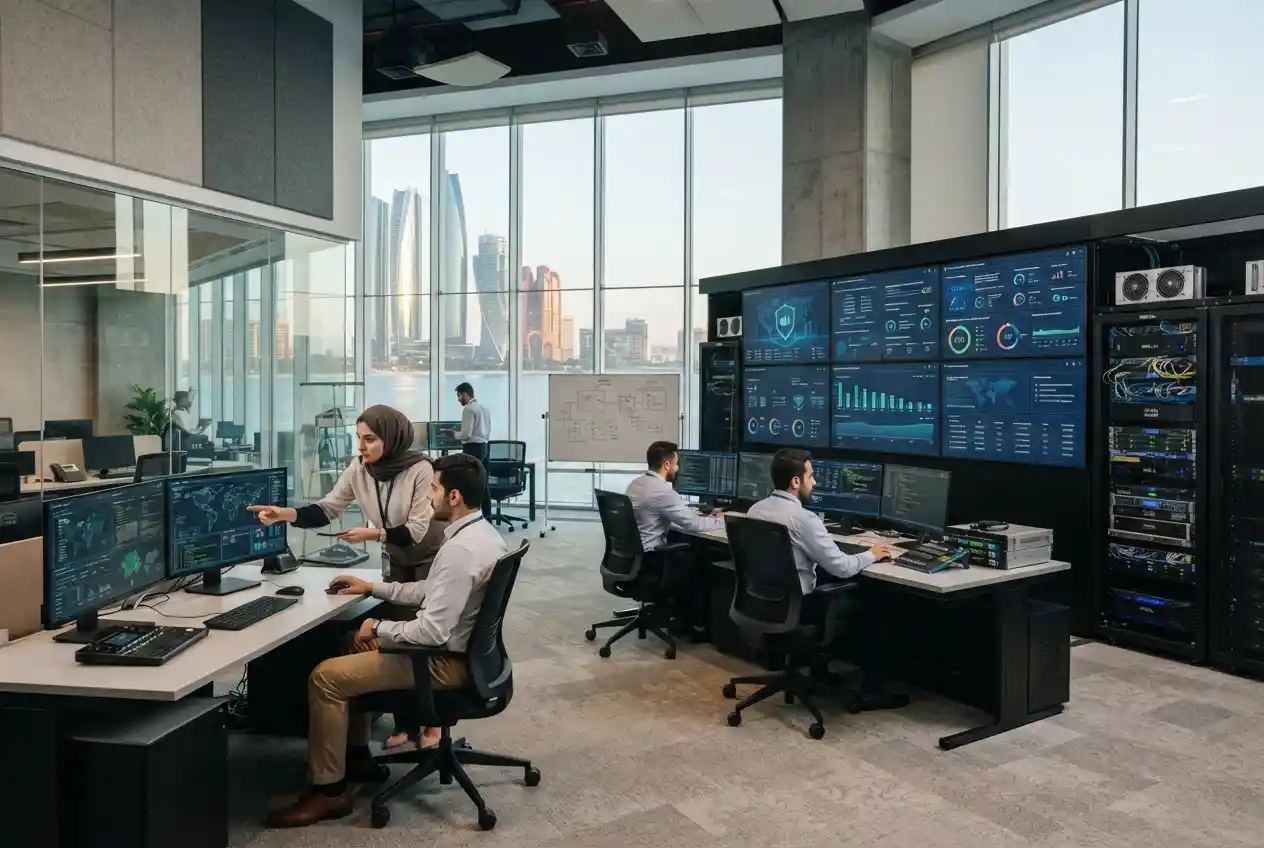
Emits Information Technology Solutions LLC is an Abu Dhabi-based technology company associated with information technology, communications, security, and audio-visual solutions. The company operates within a UAE market where businesses increasingly depend on reliable digital infrastructure, connected systems, communication technology, and integrated solutions to support daily operations.
Modern business technology extends well beyond computers and internet connections. Organizations may require structured networks, security systems, communication equipment, audio-visual technology, software, technical consulting, and ongoing support. Bringing these components together can help businesses create a more connected and manageable technology environment.
For organizations researching IT providers in Abu Dhabi, understanding the different technology services available can make it easier to identify the right solution for a particular business requirement. Technology investments are most effective when they are selected according to operational needs rather than simply following the latest technology trend.
What Is Emits Information Technology Solutions LLC?
Emits Information Technology Solutions LLC is a technology-focused business located in Abu Dhabi. Available business information associates the company with computer consulting and facilities management activities, computer equipment and software, communications equipment, and audio-visual technology. The company is also associated with the domain emits.ae.
The broad nature of these services reflects how IT companies increasingly operate across multiple technology categories. A business may need a combination of networking, communications, security, software, and audio-visual systems rather than one isolated technology product.
When evaluating an IT solutions provider, businesses should therefore examine the specific services, technical expertise, equipment, support capabilities, and project experience available for their particular requirements.
Why IT Solutions Matter in Abu Dhabi
Abu Dhabi has a diverse economy that includes government organizations, energy companies, financial institutions, hospitality businesses, healthcare facilities, construction companies, professional services firms, educational institutions, and technology-driven enterprises.
Each of these sectors depends on technology in different ways. Offices require reliable networks and communication systems, hotels may need integrated audio-visual and guest technology, industrial facilities can require specialized security and monitoring systems, while government and enterprise organizations may operate complex digital infrastructure.
This diversity creates demand for technology providers that can understand different operating environments and recommend solutions according to practical requirements.
Core Areas of Information Technology Solutions
Network Infrastructure
Network infrastructure provides the connectivity required for employees, devices, applications, servers, and communication systems to interact. A business network may include switches, routers, wireless access points, structured cabling, firewalls, and monitoring systems.
A well-designed network should account for the number of users, building layout, expected traffic, application requirements, security needs, and future expansion.
Businesses should also consider reliability. Network downtime can affect communication, cloud applications, customer service, payment systems, and other essential operations.
IT Hardware and Software
Information technology solutions can include computers, servers, peripherals, software applications, operating systems, and other technology equipment. Selecting the right combination requires an understanding of how employees and departments actually work.
For example, administrative employees may have modest computing requirements, while design, engineering, software development, data analysis, and specialized technical teams may require significantly more processing capacity.
Software selection should also consider compatibility and integration. A new application should ideally work effectively with existing systems rather than creating another isolated technology environment.
Communication Technology
Business communication depends on technology ranging from internet connectivity and email to voice systems, collaboration platforms, video conferencing, and specialized communication equipment.
Reliable communication infrastructure can help organizations coordinate employees, customers, suppliers, and partners. For companies with multiple offices or distributed teams, secure connectivity becomes particularly important.
Communication technology can also be integrated with other business systems. For example, customer-service teams may use communication platforms connected to customer relationship management systems to provide employees with more complete customer information.
Security Technology
Security has become an increasingly important component of business technology. Organizations need to protect both their digital systems and physical facilities against unauthorized access and other risks.
Technology solutions can include network security, access-control systems, surveillance infrastructure, authentication tools, endpoint protection, and other security technologies.
Physical and digital security should ideally be considered together. A secure network does not eliminate risks associated with unauthorized physical access, while a well-protected building still requires appropriate cybersecurity controls for its connected systems.
Businesses should therefore assess security across the entire technology environment.
Audio-Visual Technology Solutions
Audio-visual technology is another important area within modern business environments. Conference rooms, training facilities, boardrooms, exhibition spaces, hotels, educational institutions, and event venues may all require professional audio and visual systems.
These systems can include displays, projectors, speakers, microphones, video-conferencing equipment, control systems, digital signage, and related infrastructure.
The objective should be to create an environment where technology is easy to operate and supports the intended purpose. A conference room, for example, should allow users to start meetings, share content, and communicate with remote participants without unnecessary technical complexity.
Integrated Technology Solutions
One of the advantages of working with a technology solutions provider is the possibility of integrating different systems. Instead of purchasing separate equipment without considering compatibility, businesses can design a technology environment where different components work together.
An integrated office might combine network infrastructure, access control, surveillance, audio-visual systems, communication platforms, and centralized management.
Integration can also improve operational visibility. When systems provide useful data through centralized platforms, administrators can monitor performance and identify issues more efficiently.
IT Solutions for Small and Medium Businesses
Small and medium-sized businesses often have limited internal IT resources. Owners and employees may be responsible for technology decisions without having specialist knowledge in every area.
A technology solutions provider can help businesses establish reliable basic infrastructure, including secure internet connectivity, wireless networks, computers, cloud applications, backups, security systems, and technical support.
The most suitable solution is not necessarily the most complicated one. Small businesses should generally prioritize reliability, security, ease of management, and scalability.
As the company grows, its technology environment can then be expanded without replacing every component.
Technology for Corporate Offices
Corporate offices have increasingly become technology-rich environments. Employees may work from laptops, use cloud applications, participate in video meetings, access shared documents, and communicate through multiple digital platforms throughout the day.
This creates a need for reliable connectivity and carefully designed meeting spaces. Audio-visual technology can support presentations and collaboration, while network and security infrastructure provides the foundation for digital work.
Businesses should also consider employee experience. Technology that is difficult to use can reduce productivity even when the underlying equipment is technically capable.
Technology for Events and Meeting Spaces
Abu Dhabi hosts conferences, exhibitions, corporate events, training sessions, and other professional gatherings that can require sophisticated technology infrastructure.
Event technology may include projection systems, large-format displays, sound systems, microphones, video conferencing, streaming, digital signage, and interactive experiences.
Reliability is particularly important in event environments because technical problems can affect an entire program. Equipment should be tested before an event, and appropriate technical support should be available during important sessions.
How Businesses Should Evaluate an IT Solutions Provider
Businesses considering a technology provider should begin by defining their requirements. A clear specification makes it easier to compare solutions and identify the capabilities needed from a technology partner.
Useful evaluation criteria include:
- Relevant industry and project experience
- Technical knowledge of the required systems
- Hardware and software capabilities
- Networking and infrastructure expertise
- Security technology experience
- Audio-visual and communication capabilities
- Installation and configuration support
- Maintenance and technical support
- Scalability of the proposed solution
- Documentation and training
Businesses should also clarify which services are included in the project and which will require additional support or maintenance arrangements.
The Importance of Technical Support
Technology does not stop requiring attention after installation. Hardware can fail, software requires updates, networks can develop problems, and users may need assistance.
Ongoing technical support can help businesses resolve problems more quickly and maintain system performance.
Support arrangements should define how issues are reported, expected response times, escalation procedures, maintenance schedules, and the responsibilities of both the client and technology provider.
Cloud Computing and Modern IT
Cloud computing has become a central part of modern business technology. Companies can use cloud platforms for email, document management, collaboration, accounting, customer relationship management, storage, analytics, and other business applications.
Cloud adoption can make it easier for employees to work across different locations, but it also creates new management requirements. User permissions, authentication, data security, backup policies, and application integration all need to be considered.
An IT provider can help businesses determine which systems are suitable for cloud deployment and how they should be connected to existing infrastructure.
Cybersecurity and Connected Systems
As more business equipment becomes connected to networks, cybersecurity becomes increasingly important. This includes not only computers and servers but also cameras, access-control systems, audio-visual equipment, printers, smart devices, and other connected technologies.
Businesses should know which devices are connected to their networks and understand how they are protected. Default passwords, outdated firmware, unnecessary network access, and poorly configured devices can increase security risks.
Regular updates, access controls, network segmentation, monitoring, and employee awareness can all contribute to a stronger security environment.
IT Consulting and Business Planning
Technology decisions should be connected with business planning. Before purchasing new equipment or software, organizations should consider the problem they are trying to solve and the expected business outcome.
An IT assessment can identify current weaknesses and establish priorities. For example, a company might discover that improving network reliability is more urgent than purchasing new software.
Similarly, an organization planning rapid expansion may prioritize scalable cloud systems and centralized user management instead of continuing to add isolated technology solutions.
Digital Transformation and IT Solutions
Digital transformation involves changing how an organization uses technology to operate and serve customers. It can include automation, online services, data analytics, customer portals, artificial intelligence, cloud computing, and integrated business applications.
Reliable IT infrastructure provides the foundation for these initiatives. Without stable connectivity, secure data, appropriate software, and dependable systems, advanced digital projects can become difficult to implement.
This is why businesses should consider infrastructure as part of their long-term digital strategy rather than as a separate technical issue.
Connecting IT Solutions With the Wider UAE Technology Sector
Information technology increasingly supports specialized industries throughout the UAE. Environmental monitoring systems use networks and data platforms, solar installations rely on digital monitoring, and modern water-treatment facilities can use automation and connected sensors.
Technology therefore acts as a common layer connecting different industries.
Readers researching this broader ecosystem can also explore Emirates Sun Technologies LLC to understand how technology connects with solar and renewable-energy applications in the UAE.
Technology Planning for Future Growth
Businesses should consider future requirements when designing IT infrastructure. A system that works for ten employees may not be appropriate for one hundred employees.
Scalability can involve choosing network equipment with sufficient capacity, cloud applications that support additional users, security systems that can cover new locations, and software platforms capable of handling increased data volumes.
Future planning can reduce the need for disruptive technology replacements as the business expands.
Emerging Trends in Information Technology
Several technology trends are influencing UAE businesses, including artificial intelligence, cloud computing, cybersecurity, automation, data analytics, connected devices, and digital collaboration.
Artificial intelligence can support customer service, content processing, data analysis, software development, and business automation. Cloud platforms continue to provide flexible infrastructure, while cybersecurity is becoming more important as organizations connect more devices and applications.
The combination of these technologies means that IT providers increasingly need to understand how different systems interact rather than treating each technology as an isolated product.
Why Integrated Technology Matters
Integrated technology can reduce duplication and simplify management. Instead of operating disconnected systems, businesses can design infrastructure around shared requirements and compatible platforms.
For example, a corporate office might combine secure networking, access control, surveillance, conferencing equipment, digital displays, and cloud applications within a coordinated technology environment.
The result can be easier administration, improved user experience, and greater visibility into technology performance.
Closing Remarks
Emits Information Technology Solutions LLC represents the type of technology-focused business operating within Abu Dhabi’s diverse IT services market. Information technology solutions today can encompass networking, hardware, software, communications, security, audio-visual systems, cloud platforms, and technical support.
For UAE businesses, the key to effective technology investment is understanding how these components support specific operational objectives. A well-planned solution should be secure, reliable, scalable, manageable, and appropriate for the organization’s actual requirements.
As businesses across Abu Dhabi and the wider UAE continue adopting cloud services, connected devices, digital applications, automation, and artificial intelligence, integrated IT infrastructure will remain an essential foundation. Technology providers that can help organizations connect these different components can play an important role in supporting long-term digital growth.


